Marsala

With a population of 80,000, Marsala is the fifth-largest Sicilian municipality in number, and certainly among the more interesting, from the archeological and monumental points of view, as well as in landscape.

The territory of Marsala consists of more than one hundred districts, and its economy is based mostly on agriculture, with more than one million hectoliters of wine produced each year, as well as a large quantity of vegetables and flowers. Marsala wine (Link su Vino Marsala), in fact, is the product that put Marsala on the map, and was a leading factor in the development of the city’s economy.

Continue reading →

Erice

Erice is located on top of Mount Erice, at around 750m above sea level, overlooking the city of Trapani, the low western coast towards Marsala, the dramatic Punta del Saraceno and Capo San Vito to the north-east, and theAegadian Islands on Sicily’s north-western coast, providing spectacular views.

The bordering municipalities are Buseto Palizzolo,  Paceco,  Trapani, Valderice  and  Custonaci. The hamlets (frazioni) are Ballata, Casa Santa, Crocefissello, Napola, Pizzolungo, Rigaletta, San Cusumano and Torretta.

Continue reading →

Pachino

Pachino (Sicilian: Pachinu) (pronun. “Pah-kee-noh”) is a town and comune in the Province of Syracuse, Sicily (Italy). The name derives from the Romanword bacchus which is the Greek and Roman god of wine, and the word ino, which means wine in the Latin language; originally the town was namedBachino which eventually was changed to Pachino when, in Sicily, Italian became the official spoken and written language.

Continue reading →

Modica

According to Thucydides, the city was founded in 1360 BC or 1031 BC and was inhabited by the Sicels in the 7th century BC. It was probably a dependency of Syracuse. Modica was occupied by the Romans after the battle of the Egadi islands against the Carthaginians in the Punic Wars 241 BC, together with Syracuse and all of Sicily. Modica became one of the thirty-five decuman (“spontaneously submitted”) cities of the island and was oppressed by the praetor Verres. It became an independent municipium, and apparently a place of some consequence.

Continue reading →

Bagheria

The territory of Bagheria has an ancient history. The first vestiges take us back to prehistoric times on the Monte Porcara and at Pizzo Cannita, as well as Phoenicianand, later, Hellenistic-Roman Solunto, and on over the aqueduct bridge over theEleuterio River in late Gothic style to the Solanto barony.
From the latter there was born the town of “baroque villas“, the crowning glory of the Palermo aristocracy. The history of the cultural heritage goes hand in hand with that of the agrarian landscape: the forest, sugar cane, vineyards, tomatoes and lemons.

Continue reading →

Forza D’Agrò

Here, a few miles north of Taormina, the film director Francis Ford Coppola shot some of the most unforgettable scenes of “The Godfather” films, in Forza D’Agro and Savoca, two beautiful medieval hilltop towns between the Peloritani Mountains, which face Calabria and the Ionian Coast of Sicily.

It was in this area where Michael Corleone (Al Pacino) went to hide after shooting a New York police captain and the mafioso Solluzzo.

Continue reading →

Castel di Lucio

In Sicily one is expected to encounter many treasures that have been left there by the many civilizations and people who have occupied this central Mediterranean Island for over 2500 years, but the surprise is to encounter, on the same island, treasures of our own era in the form of Contemporary Art. Fiumara di Tusa is the location of these a hidden treasures.

Continue reading →

Piazza Armerina

The city of Piazza (as it was called before 1862) originated during the Normandomination in Sicily (11th century), when Lombards settled the central and eastern part of Sicily about 900 years ago, but the area was inhabited since prehistoric times. The city was flourishing also during Roman times, as showed by the notable mosaics at the patrician Villa Romana del Casale.

Continue reading →

Caltagirone

Caltagirone The City of  Ceramics. Santa Maria Del Monte 142 Steps of Artisan Majolica

The city’s name of Caltagirone is derived from the Arabic “qal’at-al-ghiran” meaning “Hill of Vases.” The city stays true to the meaning of its name as everything here will certainly remind you that it is definitely a city of ceramics!

Continue reading →

Archeological Museum

Archeological Museum, Caltanissetta / February 14 – March 24, 2008

“I Soli Negati” (Denied the Sun) is a contemporary art show inaugurated on February 14th at the New Archaeological Museum of Caltanissetta, Sicily, to commemorate the 1958 Sicilian Gessolungo tragedy in which fourteen sulphur miners lost their lives, and is dedicated to all miners around the world who have sacrificed their lives in mine accidents. It was brought together by the initiative of art commissioner Rosalba Panvini.

Read more

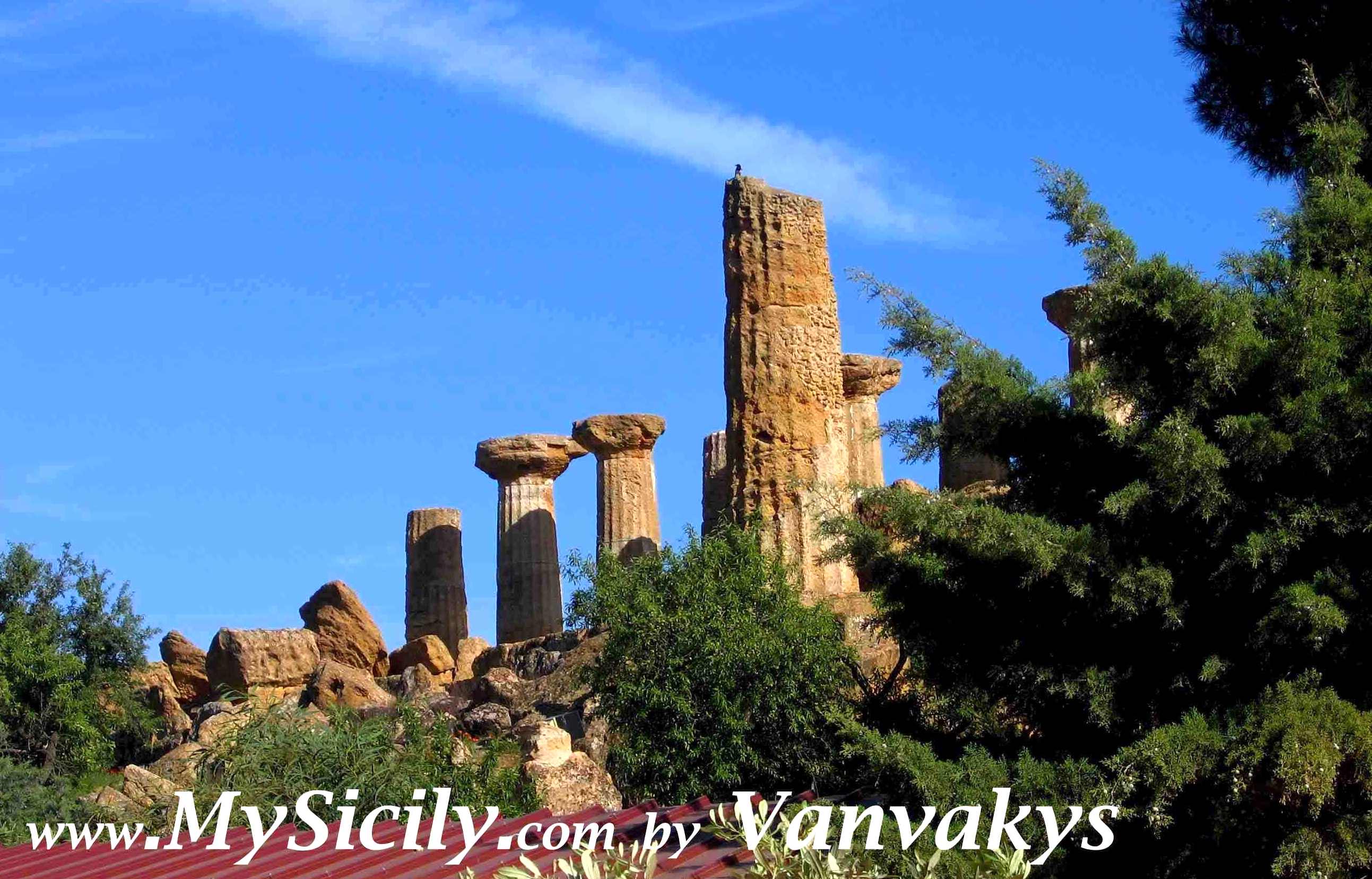
Agrigento Greek temples copy 2 Agrigento (Sicilian: Girgenti), is a city on the southern coast of Sicily, Italy, and capital of the province of Agrigento. It is renowned as the site of the ancient Greek city of Akragas (also known as Acragas (Ἀκράγας) in Greek,Agrigentum in Latin and Kirkent or Jirjent in Arabic), one of the leading cities of Magna Graecia during the golden age of Ancient Greece.

 AGRIGENTO – SELINUNTE-  MENFI –  SAMBUCA DI SICILIA – SANTA MARGHERITA BELICE – SCIACCA – RIBERA – SCALA DEI TURCHI

EVENT Sciacca - carnevale bst  copyBANNER Selinunte - 1 copyCiaoPics.com Scala dei Turchi dei turchi by Vanvakys   LE TERRE SICANE

Following the curve, that from Capo Lilibeo, leads south on the shores of the Strait of Sicily, there  is the Route of the Lands of  Sicanians or Strade del Vino Terre Sicane, (Sicanians were one of three ancient peoples of Sicily present at the time of Phoenician and Greek colonization).    This is the area of Agrigento, where, with the City of the  Valley of the Greek Temples, together with Selinunte can be considered the one of most extended archeological area in the world: here  the wine and food culture can be seen towing the economy of the area.

Archestratoterre_sicaneSmall Greek temple copy 2 go copy


Very close to, in Gela a great Siceliot-Greek poet, Archestrato of Gela (IV century BC), wrote “Hedypatheia” or “Gastronomy”, the first Poem of Gourmet. As a young poet Archestratus was disciple of the most famous Epicurus, becoming an Expert in the art of pleasure. In his poem Archestratus tells of his long journeys in search of the best food and the finest wines.   It also deals with the bread, fish, the production and storage of wine and food. It focuses mainly on fish, indicating the best quality, the places of origin, the most famous species and the specific fishing seasons. The first gourmet book in the world.

See also “history and Legends of Sicily from the kitchen to the cellar”.   

Feudo arancio _3 copykaos_franco_franchi_paolo_taviani_vittorio_taviani_012_jpg_nbmemilazzo spumante in spiaggia


Speaking of high cultural paths, in a hill facing the “abused” Valle dei Templi,  there is “Kaos” (Chaos) the house of Luigi Pirandello, the inventor of the modern theater, awarded in 1934 Nobel Prize for literature for his “bold and brilliant renovation of the drama and the stage“. - Here the DOC areas  of Sicilian Wines Here you’ll find  Santa Margherita di Belice, the summer residence of Il Gattopardo, translated  “The Leopard” written by Tomasi di Lampedusa  published in 1958,  does anybody remember the movie of Luchino Visconti with  Burt Lancaster, Alain De Lon and Claudia Cardinale. read more

MENFIBonetta Dell'Oglio e le cuoche di Menfi _3

Just few miles from Agrigento, Sambuca di Sicilia, Menfi  (nowadays one of the most active  “Slow food” presidium)  and Contessa Entellina. Beautiful beaches in this area such as: Eraclea Minoa, with its woods by the sand,  one and the UNESCO site: the white reef of “Scala dei Turchi”. – See more at: Wine Trails of Sicily III     Continue reading →

Enna

Enna (Sicilian: Castrugiuvanni; Greek: Ἔννα; Latin: Hennaand less frequently Haenna) is a city and comune located roughly at the center of Sicily, southern Italy, in the province of Enna, towering above the surrounding countryside. It has earned the nicknames “belvedere” (panoramic viewpoint) and “ombelico” (navel) of Sicily.

Continue reading →

Palermo

Palermo, Sicilian: Palermu, Latin: Panormus, from Greek: Πάνορμος, Panormos, Arabic: بَلَرْم‎, Balarm; Phoenician: זִיז, Ziz) is a city in Insular Italy, the capital of both the autonomous region of Sicily and the Province of Palermo. The city is noted for its history, culture, architectureand gastronomy, playing an important role throughout much of its existence; it is over 2,700 years old. Palermo is located in the northwest of the island of Sicily, right by the Gulf of Palermo in the Tyrrhenian Sea.

Continue reading →

Ragusa  (Sicilian: Rausa; Latin: Ragusia) is a city in southern Italy, on the island of Sicily, with around 75,000 inhabitants. It is built on a wide limestone hill between two deep valleys, Cava San Leonardo and Cava Santa Domenica. Together with seven other cities in the Val di Noto, it is listed among the UNESCO World Heritage Sites.

Continue reading →

Siracusa

260px-Siracusa_sunset

The Province of Syracuse (Italian: Provincia di Siracusa; Sicilian: Pruvincia di Sarausa) is a province in the autonomous island region of Sicily in Italy. Its capital is the city of Syracuse.

It has an area of 2,109 km², and a total population of 396,167 (2001). Syracuse has 8% of the Sicilian population and 8.2% of Sicily’s area. It is bordered on the north and north-west by the Province of Catania and on the west by the Province of Ragusa.


Siracusa’s Province Towns:

  • Augusta
  • Avola
  • Floridia
  • Pachino
  • Noto


Infiorata di NotoSiracusa - festa santa Lucia foto di Alaw_2.jpgPantalica - siracusa copyNoto_infiorata

Trapani

Trapani’s Province Towns:

  • Gibellina
  • Erice
  • Marsala
  • Mazara Del Vallo
  • San Vito Lo Capo