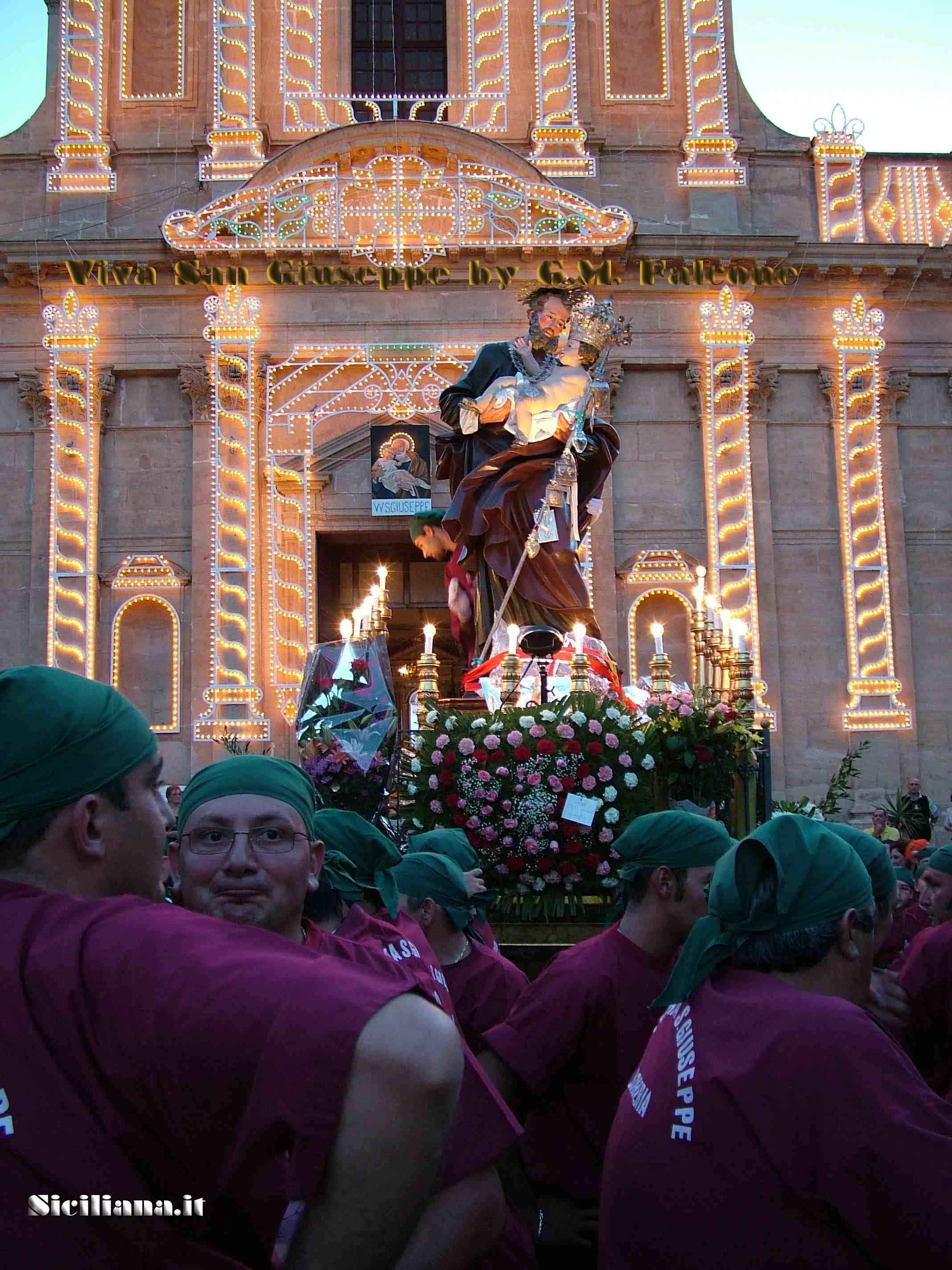
Viva San Giuseppe Bagheria by G.M. Falcone_2 2

Saint Joseph’s Day, March 19, the Feast of St. Joseph is in Western Christianity the principal feast day of Saint Joseph, Spouse of the Blessed Virgin Mary. He is also the step-father of Jesus of Nazareth/Jesus Christ. Saint Joseph’s Day is the Patronal Feast day for Poland as well as for Canada, persons named Joseph, Josephine, Pino, Pippo, Peppe, Beppe, Pine’, etc., for religious institutes, schools and parishes bearing his name, and for carpenters.

March 19th It is also Father’s Day in some Catholic countries, mainly Spain, Portugal, and Italy. Saint Joseph is also considered the patron of laborers and artisans.


In Sicily, where St. Joseph is regarded by many as their Patron men , and many Italian-American communities, thanks are given to St. Joseph (, San Giuseppi in Sicilian,”San Giuseppe” in Italian) for preventing a famine in Sicily during the Middle Ages. According to legend, there was a severe drought at the time, and the people prayed for their patron saint to bring them rain. They promised that if he answered their prayers, they would prepare a large feast to honor him. The rain did come, and the people of Sicily prepared a large banquet for their patron saint. The fava bean was the crop which saved the population from starvation and is a traditional part of St. Joseph’s Day altars and traditions. Giving food to the needy is a St. Joseph’s Day custom.

In some communities it is traditional to wear red clothing and eat ” Maccu of St. Joseph”, “Sfingi di San Giuseppe”, the Siciliana version of a Neapolitan pastry known as a Zeppole (created in 1840 by Don Pasquale Pinatauro in Napoli) on St. Joseph’s Day.

fave-verdiSfince di San Giuseppe with ricotta from Piana byVanvakys_2 copyMySicily.com  Bread Sicily by Vanvakys

Upon a typical St. Joseph’s Day altar, people place flowers, limes, candles, wine, fava beans, specially prepared cakes, breads, and cookies (as well as other meatless dishes), and zeppole. Foods are traditionally served containing bread crumbs to represent saw dust since St. Joseph was a carpenter. Because the feast occurs during Lent, traditionally no meat was allowed on the celebration table. The altar usually has three tiers, to represent the trinity.

On the Sicilian island of Lipari, The St. Joseph legend is modified somewhat, and says that sailors returning from the mainland encountered a fierce storm that threatened to sink their boat. They prayed to St. Joseph for deliverance, and when they were saved, they swore to honor the saint each year on his feast day. The Liparian ritual is somewhat changed, in that meat is allowed at the feast.

Some villages like Avola used to burn wood and logs in squares on the day before St.Joseph, as thanksgiving to the Saint. In Belmonte Mezzagno this is currently still performed every year, while people ritually shouts invocations to the Saint in local Sicilian language. This is called “A Vampa di San Giuseppe” (the Saint Joseph’s bonfire). In Villabate, a small town at the threshold of Palermo, the traditional  “Vastuni di San Giuseppi”, the stick of Saint Joseph, consisting of a tall and heavy rod adorned adorned with flowers and fruits, is carried in procession, around the town to shoulder of men of a congregation dedicated to the worker’s saint.

Vampa Joebastone2CiaoPiics.com Natura Sicily Springtime_11 copy

Spectacular celebrations are also held in Bagheria. The Saint is even celebrated twice a year, the second time being held especially for people from Bagheria who come back for summer vacation from other parts of Italy or abroad.


In the United States

In New Orleans, Louisiana, the city of Louis Prima & Louis Armstrong, and home of  Nick La Rocca and the Dixieland Band, to name few  which was a major port of entry for Sicilian immigrants during the late 19th century, the Feast of St. Joseph is a city-wide event. Both public and private St. Joseph’s altars are traditionally built. The altars are usually open to any visitor who wishes to pay homage. The food is generally distributed to charity after the altar is dismantled.There are also parades in honor of St. Joseph and the Italian population of New Orleans which are similar to the many marching clubs and truck parades of Mardi Gras and St. Patrick’s Day. Tradition in New Orleans also holds that by burying a small statue of St. Joseph upside down in the front yard of a house, that house will sell more promptly. In addition to the above traditions, some groups of Mardi Gras Indians stage their last procession of the season on the Sunday nearest to St. Joseph’s Day otherwise known as “Super Sunday,” after which their costumes are dismantled.
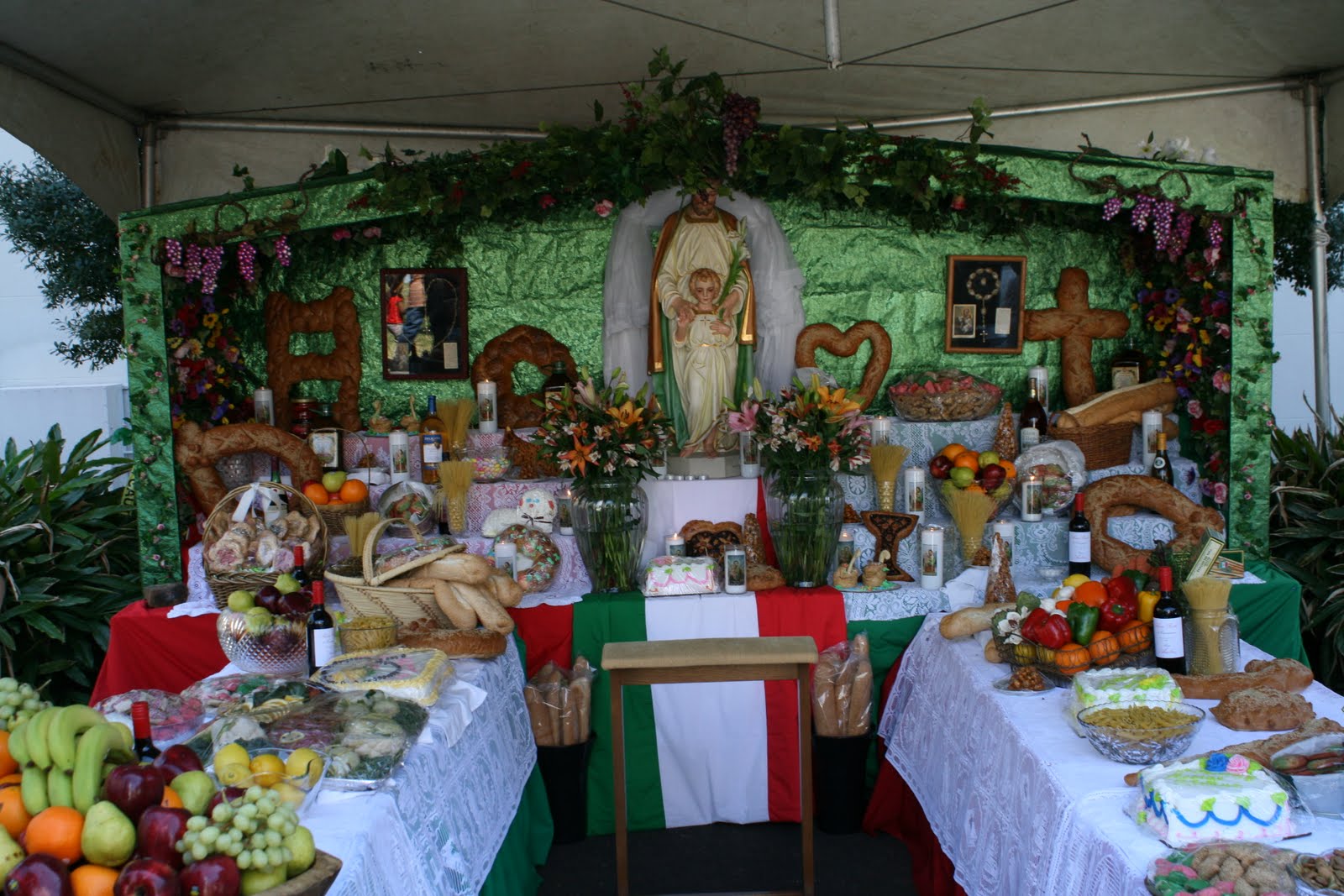
Saint Joseph's Day New OrleansSaint Joseph's Day in USA Saint Joseph's Day New Orleans


Saint Joseph’s Day is also celebrated in other American communities with high proportions of Italians such as New York City; Utica, NY, Syracuse, NY, Buffalo, NY, Hoboken, NJ, Jersey City, NJ; Kansas City, MO; and Chicago; Gloucester, Mass., Providence, Rhode Island, where observance (which takes place just after Saint Patrick’s Day) often is expressed through “the wearing of the red”, i.e., wearing red clothing or accessories similar to the wearing of green on Saint Patrick’s Day. St. Joseph’s Day tables may also be found in Rockford and Elmwood Park, Illinois.

excerpt from Wikipedia edited by Vanvakys.com
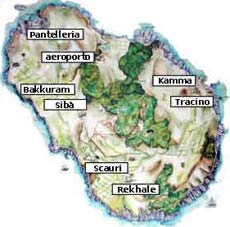
PANTELLERIA

Pantelleria (Sicilian: Pantiddirìa), the ancient Cossyra (Maltese: Qawsra, now Pantellerija), is an Italian island in the Strait of Sicily in the Mediterranean Sea, 100 km (62.1 mi) southwest of Sicily and just 60 km (37.3 mi) east of the Tunisian coast. Administratively Pantelleria is a comune belonging to the Sicilian province of Trapani. With an area of 83 km2 (32 sq mi), it is the largest volcanic satellite island of Sicily.

The island of Pantelleria is located above a drowned continental rift in the Strait of Sicily and has been the locus of intensive volcano-tectonic activity. The 15-km-long (9.3 mi) island is the emergent summit of a largely submarine edifice

The Island has a very developed agriculture system, despite the weather (very hot in Summer)  and the cultivated area, that are located over the  hills and steep terrains: do not to be missed the famous Passito Wine a DOC , and the cappers.

Source : Wikipedia.org edited by Vanvakys

By Hydrofoils for Time Schedule and more info visit: www.Usticalines.it

By ferries for Time Schedule and more info visit: Siremar


PELAGIE ISLANDS

The Pelagie Islands (Italian: Isole Pelagie, Sicilian: Ìsuli Pilaggî), from the Greek pélagos – πέλαγος meaning “open sea”, are the three small islands of Lampedusa, Linosa, and Lampione, located in the Mediterranean Sea between Malta and Tunisia, south of Sicily. To the northwest lie the island of Pantelleria and the Strait of Sicily. Geographically part of the archipelago (Lampedusa and Lampione) belongs to the African continent; politically and administratively the islands fall within the Sicilian province of Agrigento and represent the southernmost part of Europe.

Of particular ecological concern in the islands is the protection of the Loggerhead Turtle (Caretta caretta) which is endangered throughout the Mediterranean as a result of its nesting sites being taken over by tourism. In Italy the beaches of Pozzolana di Ponente on Linosa and Isola dei conigli on Lampedusa are the last remaining sites where the turtle regularly lays its eggs. The Area Marina Protetta Isole Pelagie nature reserve, covering all three islands, was instituted in 2002.

Source : Wikipedia.org edited by Vanvakys

By Hydrofoils for Time Schedule and more info visit: www.Usticalines.it

By ferries for Time Schedule and more info visit: Siremar

AEGADIAN ISLANDS


The Aegadian Islands (Sicilian: Ìsuli Ègadi, Italian: Isole Egadi; Greek: Aegatae Nisoi, Αιγάται Νήσοι, meaning the islands of goats), are a group of small mountainous islands in the Mediterranean Sea off the northwest coast of Sicily, Italy, near the city of Trapani, with a total area of 14.46 square miles (37.45 km2).

Favignana (Aegusa), the largest, lies 10 miles (16 km) south west of Trapani; Levanzo (Phorbantia) 8 miles (13 km) west; while Marettimo, the ancient Iera Nesos, 15 miles (24 km) west of Trapani, is now reckoned as a part of the group. There are also two minor islands, Formica and Maraone, lying between Levanzo and Sicily. For administrative purposes the archipelago constitutes the comune of Favignana in the Province of Trapani..

Source : Wikipedia.org edited by Vanvakys

The nearest airport is Trapani  see Sicily by Plain

By Hydrofoils for Time Schedule and more info visit: www.Usticalines.it

By ferries for Time Schedule and more info visit: Siremar

Ustica


Ustica (Sicilian: Ùstica) is a small island, about 9 km across, situated 52 km north of Capo Gallo, Palermo, in the Tyrrhenian Sea. Roughly 1,300 people live in the comune (municipality) of the same name. There is regular ferry and hydrofoil service from the island to Palermo.In  Ustica had been created the first Marine Park in Europe: a real “Paradise for divers” 

By Hydrofoils for Time Schedule and more info visit: www.Usticalines.it

By ferries for Time Schedule and more info visit: Siremar


Related Links: Palermo City /  Sicily by Boat 

Other Minor Islands of Sicily / Aegadian Islands/  Aeolian Islands / Pantelleria / Lampedusa – Linosa


Mini-cruise to the Island of the Currents

An excursion by boat is the best way you can choose to cross the beautiful sea in the far south of Sicily. Boarding either rubber dinghies, motorboats or sailboats your experience starts from the Marina Marzamemi, and explores a stretch of coastline unspoilt. At 7.30am you set sail for the Isle of Capo Passero, just opposite the village of Portopalo.

You will arrive on the island by sea, but in summer, at low tide, the island can also be reached on foot from Portopalo, thanks to a sandy isthmus that joins the mainland. Navigating around the island, you can see the Cave of the Octopus and the small traps which were used to catch tuna that once swam under the tip of the island.

To the north of Capo Passero stands the fortress from the XVII century, commissioned by Philip III, grandson of Charles V, to look out for ships and fight the Saracen pirate raids. At Portopalo, at the extreme southern tip of Sicily, the rhythm is slow and life relaxed. Due to its strategic position, Portopalo was in previous centuries a trading port of considerable importance for those who had sailed the Mediterranean.

The current village, which dates back to XIX century, was established around a few old fishermen’s houses, still visible, in a stretch of coastline called Scalo Mandrie, just opposite the island of Capo Passero.

Continue sailing to the Isola delle Correnti known as surfer’s paradise. A small rocky island, round in shape, located where the Mediterranean meets the Ionian sea, creating strong currents which are also fueled by the winds that often blow up this stretch of coast. You will see the windsurfers whizzing sails, opened for their maximum enjoyment. Returning to port, go to the beach for a barbecue near the sea.

Plan your cruise with the diving center El Cachalot, they are expert and will arrange it all for you so all you have to do is have fun!

Distance 6km fromPachino (SR)

To visit Marzamemi and Portopalo:
from Pachino (Siracusa) take the SP84 and SP21

Suggested by Amuni’Sicily

El Cachalote Diving Center
Marzamemi (SR)
Tel +39 0931. 801107 Mobile +39 331.9265249 Mobile 366.3188452

Web: www.elcachalote.com

Snorkeling and birdwatching at Vendicari

To get away from the city and get touch with nature, visit the Nature Reserve of Vendicari: an oasis of sand, rocks and natural lakes. We recommend that you enter from the north gate Eloro, just 8 km from Noto, to enjoy a more complete tour of the oasis.

This takes in the Big and the SmallLakes,The Swabian Tower and The Tonnara.

All around you are, ancient ruins and archaeological excavations testifying the Hellenistic, Byzantine and Medieval tracks in the reserve. Bring binoculars, because the reserve is home to many varieties of birds, over 180. Several varieties of plants, along with freshwater and brackish lakes, creating ideal conditions for a natural balance between land and water. Some flamingos, herons and moorhensmay come close to you, as they live in the reserve. But the true stars here are the thousands of ducks wading in a freshwater lake. If you arrive from Pachino , the city of the famous “cherry tomato” and fine wines, in the South, the gate to the Reserve is Cittadella.

Halfway along SP19 road, however, you will find the Calamosche entrance, certainly the best known because it leads to a paradise beach . Almost 1km in length, the path is rough and can be done on foot only. So do not forget hats and plenty of fresh water. At the end of the path, after 120 steps, a wonderful sight is in front of you.

Crystal clear waters there to be explored by snorkeling.

N.B. bring your need for your stay as the beach is not equipped.

Distance
85 km from Catania
30 Km fromNoto

by Car
From Catania: Autostrada Siracusa-Catania (Highway E45) exit to Cassibile,take the SS115 road to Noto then take the SP19 Noto-Pachino . Proceed for 8Km then you’ll find directions to the left to Riserva di Vendicari

Parking only during the Summer season
Auto € 3
Motorbike € 3
Camper or AR € 12

Bus
AST linea Catania-Siracusa-Modica Tel +39 0931.46271

SAIS from Catania – Tel +39 095.536168


Visualizzazione ingrandita della mappa

Azienda Regionale Foreste Demaniali

Via Giovanni alle Catacombe – Siracusa
Continue reading →

Jiménez Deredia / Trapani – Segesta


Costa Rican sculptor Jiménez Deredia presents a cycle of monumental sculptures and works in white marble on the historical-symbolic path leading to the Segesta Archaeological Park in Trapani, one of the most beautiful antique sites in the world.
A selection of the Latin American artist’s work can be seen at the Birgi Airport “Vincenzo Florio”, used for the first time as an exhibition venue for contemporary art, in Trapani’s Historical Centre with its Corso Vittorio Emanuele in front of the church Chiesa del Collegio dei Gesuiti (currently next to the High School “Leonardo Ximenes”) and the Piazza del Mercato del Pesce. A significant part of his artistic production will confront the fascinating religious venues of the archaeological site’s Agora – the largest in the Mediterranean -, the Theatre and the Doric Temple in Segesta, thereby bridging the gap between past and present. Deredia presents for the first time his new work Armonia in white Carrara marble.

THE LEGEND OF DIONYSUS – The arrival of the vines in Sicily

As we well know, the ancient Greeks, and then the Romans, loved myths and legends – myths and legends that were recorded by the eminent poets and philosophers of their time, and who remain fundamental to western culture today, including Socrates, Plato and Aristotle, just to name a few.

Their narratives touched upon weakness and virtue, nobility and gods, and depicted women and men who confronted wars and adventures, whether for passion or simply in search of a better understanding of the mysteries of the world and this life.

According to some of these legends, it was jealousy that precipitated the arrival of grapevines in Sicily. Zeus, the father of the gods, and always on the lookout for new love interests, fell for Armonia, a beautiful young maiden. It was his wife Hera who, upon learning of this betrayal, went straight for the counterattack, transforming herself into the young maiden’s food, and convincing the young girl to ask Zeus to appear to her in all of his majestic splendor with which he ruled Olympus.

Armonia was already pregnant when, between claps of thunder, and flashes of lightning, Zeus appeared. The glorious sight was too much for her to bear, and the strength of her emotion caused her to give birth prematurely, shedding light on a most breathtakingly beautiful baby boy.

At that moment, Zeus recognized the foul play, and immediately sewed the infant to one of his legs, completing the gestation period much as an incubator would, and for this reason, the child was called “Dionysus,” that is, the son of Zeus, the god of fertility, joy, and well-being. Dionysus decided to leave the Ellade and escape to Sicily, bringing a grape vine with him. As he was undertaking a long sea voyage, and needed to protect the small plant from the elements, he first placed it inside the bone of a bird, and later inside that of a lion, and since it kept growing, he finally placed it in the bone of a donkey. Thus was born the first ancient rule of drinking, and which is still worth remembering today: “A good glass of wine makes you light as a bird, another drink and you are courageous as a lion, but when you exaggerate with wine, you end up an ass!.” Upon his arrival in Sicily, Dionysus planted the first vineyard at Naxos, just below Taormina, the first Greek colony.


Read More about the Arrival of Wines in Sicily 


Lorem Ipsum is simply dummy text of the printing and typesetting industry. Lorem Ipsum has been the industry’s standard dummy text ever since the 1500s, when an unknown printer took a galley of type and scrambled it to make a type specimen book. It has survived not only five centuries, but also the leap into electronic typesetting, remaining essentially unchanged. It was popularised in the 1960s with the release of Letraset sheets containing Lorem Ipsum passages, and more recently with desktop publishing software like Aldus PageMaker including versions of Lorem Ipsum.

Lorem Ipsum is simply dummy text of the printing and typesetting industry. Lorem Ipsum has been the industry’s standard dummy text ever since the 1500s, when an unknown printer took a galley of type and scrambled it to make a type specimen book. It has survived not only five centuries, but also the leap into electronic typesetting, remaining essentially unchanged. It was popularised in the 1960s with the release of Letraset sheets containing Lorem Ipsum passages, and more recently with desktop publishing software like Aldus PageMaker including versions of Lorem Ipsum.